

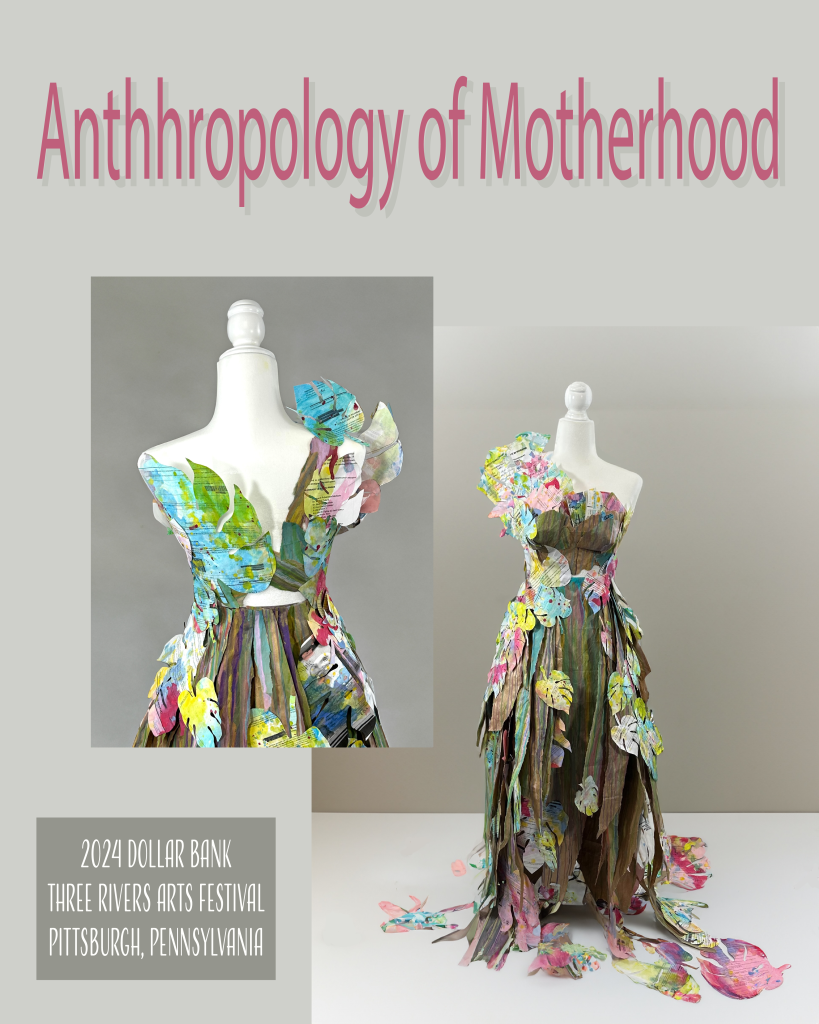
My participation in the Three Rivers Arts Festival in Pittsburgh, Pennsylvania in 2024 as part of the Anthropology of Motherhood was an incredible experience. AOM Kinship and Othermothering ‘explore(s) the diverse interpretations and contemporary expressions of kinship – the bonds that connect us, whether by blood, friendship, community, or shared experience – as models of solidarity, activism, and resistance that have the potential to generate robust infrastructures of care.’
The following is taken directly from the prospectus utilized for the exhibition:
AOM supports and aims to uplift intersectional and interdisciplinary visual artists, designers, and creative practitioners through a curatorial model of care. As such, we welcome creatives and artists from all backgrounds and identities to submit their work/projects/proposals. We encourage submissions that challenge ableist, Western, heteronormative, patriarchal and capitalist notions of kinship and offer alternative models rooted in diverse lived experiences and cultural contexts.
Within maternal feminist discourses, kinship is often defined and understood through the lens of the care paradigm, caregiving, nurturing relationships, and values of the maternal. The AOM project is grounded in a maternal feminist lens that emphasizes the value of maternal roles and qualities, carework and complex networks of nurturing relationality in both private and public spheres.
In addressing the complexity and fluidity of kinship, we look to black feminist scholars such as Patricia Hill Collins, who coined the terms “Othermothering” and “Community Mothering,” which, according to Kaila Adia, “has been defined as a form of mothering that is rooted in political activism and within a Black Feminist paradigm. It is the concept of accepting responsibility for a child that is not one’s own in an arrangement that may or may not be formal. Although motherhood is a contradictory institution experienced in diverse ways by different women.”
For this exhibition, we look to Queer kinship, which refers to the ways in which the LGBTQIA2S+ community forms familial and close relational bonds that may or may not conform to patriarchal notions of family and kinship. Queer kinship articulates the ways in which queer-identifying people create and sustain meaningful relationships in the context of broader societal structures that privilege heteronormative family models, such as through “chosen families.”
We also center indigenous concepts of kinship, which differ widely among various cultures around the world, but often share certain characteristics that distinguish them from Western notions of kinship such as: extended family structure, non-biological ties, clan and totem systems, and a connection to land and ancestors.Since 2016,
Anthropology of Motherhood has provided ongoing curation of artwork and design that engages in the complex visual, material, emotional, corporeal and lived experiences of motherhood, care-giving, parenting, nurturing and maternal labor. As an annual hybrid amenity/exhibit at the Three Rivers Arts Festival, our message and aesthetic of the Culture of Care has reached thousands of viewers, instilling the value of caregivers and the importance of prioritizing compassion and care in our daily lives. Our exhibits have traveled to McDonough Museum of Art, Sleeth Gallery and will be exhibiting at Dyers Art Center in Rochester, NY in 2023. With support from the Opportunity Fund (Pittsburgh) and in collaboration with the City of Asylum, we recently concluded our speaker series, Culture of Care inviting artist-caregivers from around the world to share where caregiving and receiving intersects with their practice.
I had never participated in the festival before, though I’ve attended almost every year since moving to Pittsburgh. We love the festival. If you have an opportunity to attend, please do. I hope that you enjoy the experience.
Paper Pregnancy
Mixed Media Collage
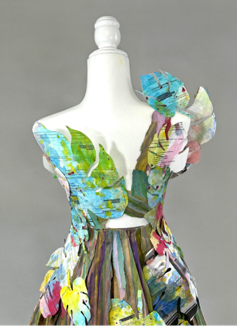
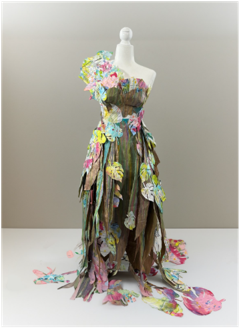
Dimensions/Size of Art: 60” tall, 35” deep at the base, 55” wide at the base
Artist Statement:
Adorned with dossiers for three of Haiti’s jewels, and finished with the powerful signature of approval of the process, each torn and lightly tacked tendril represents a month in the process of advocating for my children. Each color is symbolic of need, loss, survival, threat, and beauty. A mother must be strong but delicate when building a relationship with an emotionally traumatized child. Some do not let love in. The work merely begins when the process is finalized. Entering the world of a child adopted sometimes means not only adopting the child, but an entire family. That has been the case for our family. We intended to adopt one child, and our hearts were opened to adopting three children. Beyond that, we became members of a wider family that has grown to become a network of family, friends and a beautiful legacy of heartbreak that exists on an island that has held our hearts since 2010 when we naively began a process that never ended but instead has merely evolved as our children have grown. After living in-country twice, immersing in the culture, and learning the language to advocate for our children, we know now that we are not just parents to our children. We are part of a growing tree, rooted in a family’s history and our children have become branches in the trees of cultures they had never experienced as well. Like grafting fruit from separate trees, this process requires careful nurturing of the foreign, fledgling additions. To help everyone thrive, wounds need to be nursed with ongoing care to prevent rejections of the bond. If the attachment is successful, beautiful flowering and production of different kinds of fruit can live on for generations. The creation of this piece was intended to display the duality of the intentions of mothers. Love and suffering. Happiness and pain. A third mother is involved, and that is the Land of Mountains, Ayiti, a place that much has been taken from. When the land was over-processed and abused by deep over-forestation, it was left malnourished and incapable of retention. Now it is prone to epic and dangerous, catastrophic and torrential events when small storm cells arrive. This displaces hundreds of thousands, leaving them homeless and abandoned. The duality of poured paint on paper that has seen many days, folds, and flights represents sorrow, tears, and flooding rains that rip apart the earth as it rushes down upon ill-fortified, nutrient-lacking soil of over-forested land, it weeps. The people cry out praises, despite their suffering. They immediately begin to rebuild whatever they can survive within, and they wait for the sun to rise. They sing. They pray. They spend long, sleepless nights filled with hope that the next day will be eased, and they will suffer less. When an opportunity arises for a child to be fed, educated, and have a prosperous life, they celebrate the ability to give these provisions to their children and profess love for the women and families willing to love their children. How can we not love them, fully, the way we love their children? Is it not the least that we can offer them knowing that we cannot stop the rain? Witnessing it evokes the deepest empathy for the suffering of these immeasurably wounded women who watch as their children leave their mother country. Their mothers are suffering. The island is suffering. The future of this beautiful place we have called home is crumbling. Haiti’s children are leaving.